
Causal AI for Oil and Gas
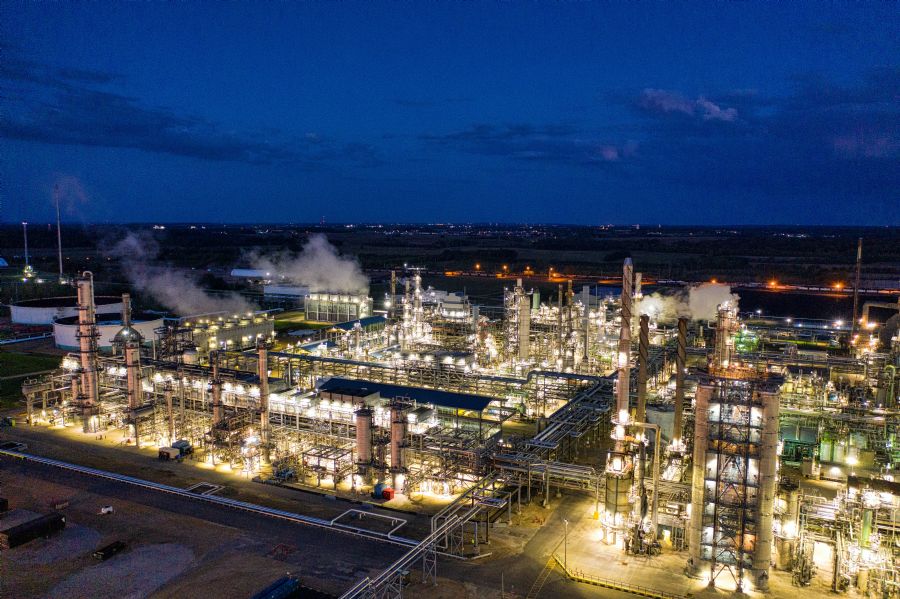
AI is Driving Value in the Oil and Gas Sector
Faced with changing regulations, emerging competition and continuous market volatility, businesses in the oil and gas industry are putting a priority on transforming their operations. These market pressures are not new to the industry and are the reason why oil and gas businesses have regularly invested in new technologies. For example, several industry leaders were early adopters of big data, and AI – with a goal of balancing efficiency and profitability without sacrificing safety. Unlike other industries who are still exploring the potential of AI, oil and gas AI use cases in production span a wide array, from exploration and drilling operations to delivery and consumer retail. The business benefits across the entire value chain is clear and business are investing heavily. A recent EY survey indicated that more than 92% of oil and gas companies around the world are “either currently investing in AI or plan to in the next two years.”
Building on this momentum, oil and gas companies increasingly turning their focus towards the next frontier in artificial intelligence: Causal AI. This emerging approach to data and AI is a significant evolution from traditional AI that is grounded in correlations. Instead, Causal AI focuses on the power of understanding cause and effect relationships. This deeper insight into understanding why things happen, and how to change outcomes empowers leaders to make better decisions that can optimize operational efficiencies, reduce downtime, enhance strategic planning, and ultimately increase profitability without sacrificing safety or environmental risks.
“Hydrocarbon extractors are finding an ally in AI to facilitate operational predictability as well as assistance in meeting their carbon emissions targets.”
Gaurav Sharma, Senior Contributor at Forbes [reference]
Causality is Revolutionizing Decision-Making
The science of causality, and its application within business through Causal AI, is being adopted because traditional AI can’t answer some of the most pressing questions that business leaders have. These leaders want answers to questions like “what happens if?”, “how does X effect Y?”, “Why did something happen and how can we repeat that or prevent it from happening in the future?”
Additionally, getting the root cause of a problem is necessary, but a task that AI struggles with. For example, in the oil and gas industry, predictive maintenance applications are extremely powerful – for example they can tell you that a drill is likely to fail within 3 days and needs a part repaired. However, these systems are a black box and do not tell you why your equipment is experiencing higher than usual maintenance.
By leveraging the power of understanding cause and effect relationships, oil and gas executives are able to more confidently make data driven decisions. While traditional AI is important, and there are many strong use cases, this approach is unable to distinguish causal relationships from correlations in the data. This shortcoming means that critical decisions might be made because of mere correlations.
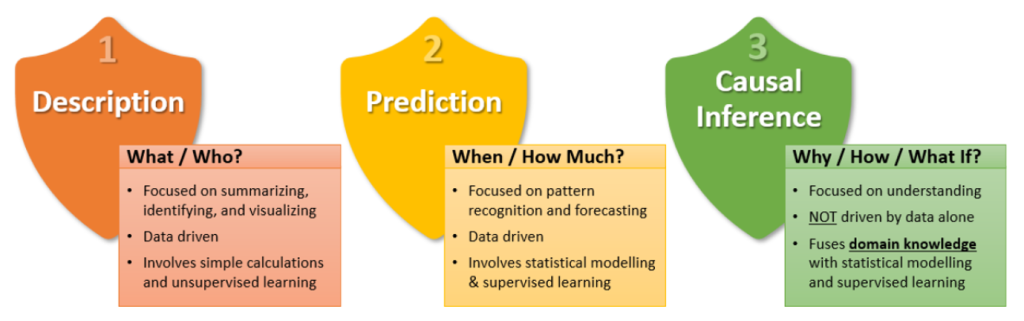
Hernán et al 2019: A Second Chance to get Causal Inference Right – A Classification of Data Science Tasks
The business community across industries is seeing the importance of Causal AI. The industry analyst firm, Gartner has included Causal AI in its 2023 Hype Cycle for Emerging Technologies. This inclusion is based on deep research, surveys, and conversations with 12,000 organizations globally. Gartner’s Hype Cycle is an objective assessment that early adopters of Causal AI can expect to see significant business benefits.
The Oil and Gas Industry Turns to Causal AI
Primarily due to the global energy transition to cleaner technologies, oil and gas companies are under pressure to quickly transform the ways they do business. Causal AI is proving to be a competitive advantage for organizations that are going through these transformational efforts.
Taking a causal approach to business problems allows members throughout an organization to make better decisions and improve outcomes. This technology allows data science teams, subject matter experts and business teams to collaborate on data, Causal AI models and the power of making better decisions based on cause and effect. Causal AI is building significant momentum, and several top-five oil and gas companies in the world are already investing heavily in the technology.
A very large oil and gas company recently hosted their own Causal Inference Symposium, with Turing Award winner Judea Pearl delivering the keynote. The UCLA professor is well known for his development of do-calculus, the mathematical underpinning of causal inference. The scale and extent of this event is a clear indicator of the company’s significant interest in Causal AI. Professor Pearl is a firm believer that a key limitation of current machine learning approaches is a lack of causal understanding, and the resolution of this issue presents an opportunity for a significant advancement in the state-of-the-art.
“Machines’ lack of understanding of causal relations is perhaps the biggest roadblock to giving them human-level intelligence.”
Judea Pearl, Turing Award winner and AI pioneer [reference]
Causal AI Use Case Examples for Oil and Gas
Upstream (Exploration and Production)
| Question | Decisions | Outcome |
|---|---|---|
| What factors most significantly impact drilling efficiency? | Adjusting drilling techniques and equipment based on geological data. | Enhanced drilling efficiency and reduced operational costs. |
| How does weather impact offshore production rates? | Adjusting production schedules and safety protocols in response to weather forecasts. | Optimized production rates while ensuring worker safety. |
| Which reservoir characteristics lead to the highest yield? | Prioritizing exploration and drilling efforts in areas with favorable characteristics. | Increased yield and more efficient resource allocation. |
Midstream (Transportation and Storage)
| Question | Decisions | Outcome |
|---|---|---|
| How can pipeline leaks be predicted and prevented? | Implementing predictive maintenance and monitoring strategies for pipelines. | Reduced environmental impact and lower repair costs. |
| What is the optimal routing for transportation to minimize cost and time? | Planning transportation routes and schedules based on real-time data. | Enhanced logistics efficiency and reduced transportation costs. |
| How does storage capacity impact supply chain efficiency? | Adjusting storage strategies based on demand forecasts and capacity analysis. | Improved supply chain management and reduced bottlenecks. |
Downstream (Refining and Marketing)
| Question | Decisions | Outcome |
|---|---|---|
| What refining processes are most impacted by crude quality variations? | Adjusting refining processes based on incoming crude quality. | Consistent product quality and reduced waste. |
| How do market trends impact fuel pricing strategies? | Adapting pricing strategies based on real-time market analysis. | Optimized pricing for market conditions and increased profitability. |
| What factors influence consumer energy demand? | Tailoring marketing and product offerings based on consumer behavior analysis. | Enhanced customer satisfaction and loyalty. |
Cross-Sector
| Question | Decisions | Outcome |
|---|---|---|
| How do regulatory changes impact operational strategies? | Adapting compliance and operational strategies in response to new regulations. | Ensuring regulatory compliance and minimizing disruption. |
Conclusion
In conclusion, the oil and gas sector is at the forefront of a paradigm shift, with Causal AI emerging as a game-changer in how these companies approach decision-making and operational efficiency. The adoption of this advanced technology underscores a pivotal transition from reliance on traditional AI’s correlation-based insights to a more profound, cause-and-effect understanding. This shift is not merely about adopting new technology; it’s about embracing a fundamentally different way of thinking that can redefine industry standards. As Causal AI gains traction, we are witnessing a transformation where data-driven insights lead to more strategic, effective, and safer operational practices. The industry’s heavy investment in Causal AI is a testament to its potential to revolutionize decision-making processes, ultimately leading to optimized operations, reduced environmental impact, and enhanced profitability. As companies continue to navigate the complexities of the global energy landscape, Causal AI stands as a beacon of innovation, driving the oil and gas sector towards a more sustainable, efficient, and future-ready era.