
There’s a quiet mistake playing out across enterprise AI right now. Too many organizations are trying to solve every problem with the same tool—usually an LLM, sometimes “agents” and occasionally whatever their vendor has most recently rebranded.
The progress in generative AI has been extraordinary, so the instinct is understandable, but the reality inside enterprises is more nuanced than that.
The most effective AI-driven systems are not built on a single paradigm. They are assembled by applying different forms of intelligence to different parts of the problem, with some elements automated, others left deterministic and certain decisions deliberately kept under human control.
That is the real shift: moving away from simply “using AI” toward designing systems that use the right kind of intelligence, with the right level of human involvement, in the right place.
Different Problems, Different Forms of Intelligence
Even within a single enterprise workflow, you are dealing with very different types of problems.
Some are about understanding—interpreting contracts, policies or internal documentation, and making sense of how those pieces relate to one another. These are inherently ambiguous tasks, and this is where LLMs are genuinely powerful, provided they are grounded in something more structured than a loose collection of documents.
Others are about decision-making—understanding why something happened, what will happen if you intervene and how to choose between competing options. In these cases, predictive models are not enough, because correlation does not tell you what to do. This is where causal AI becomes critical.
Then there is execution, which is often overlooked in AI discussions. Moving data, enforcing rules and running workflows are not ambiguous problems at all; they require precision and repeatability, which is why deterministic code continues to underpin most enterprise systems.
Trying to force all of these into a single approach is where many initiatives start to break down.
Why LLMs Need Structure
LLMs are exceptional at interpreting language, but they are not inherently reliable in the way enterprise systems need them to be.
When left unstructured, they struggle with consistency, with understanding precedence across documents and with maintaining context over large and fragmented bodies of information. The result is often answers that are plausible but subtly wrong, which is exactly the kind of failure that is hardest to detect and most difficult to trust.
This is where many early “agentic” systems have run into trouble. The demonstrations are compelling, but the behavior in production tends to drift over time.
One of the clearer lessons from the past year is that autonomy without structure, and without oversight, does not scale in an enterprise setting
The Role of the Enterprise Knowledge Graph
An Enterprise Knowledge Graph fundamentally changes how these systems behave.
Instead of asking an LLM to infer meaning from disconnected fragments, an EKG provides an explicit representation of how the organization’s knowledge fits together, capturing entities, relationships and context in a way that is both machine-readable and understandable to humans.
This grounding makes the LLM far more reliable, because it is no longer guessing at relationships but navigating a structured map. At the same time, it creates a natural place for human expertise to be embedded, allowing subject matter experts to resolve ambiguity, align terminology and refine how concepts relate to one another over time.
In practice, this is where human-in-the-loop becomes part of the system itself rather than a safeguard bolted on at the end. The quality of the outcomes improves not just because the models improve, but because the underlying representation of knowledge becomes more coherent and better aligned with how the organization actually operates.
Agents as Orchestrators, Not Magic
Much of the current conversation around enterprise AI has shifted toward agents, often framed as autonomous systems that can reason and act independently.
What is emerging in practice is more grounded than that.
Agents are most effective when they act as orchestration layers, breaking problems into steps, selecting the appropriate tools and coordinating between systems. Their performance is entirely dependent on the quality of those underlying components, which means that weak retrieval, unstructured knowledge or simplistic models quickly translate into unreliable outcomes.
Real-world deployments have tended to converge on a more balanced model, where autonomy is introduced selectively and combined with clear points of human oversight. High-impact actions are reviewed, ambiguous situations are escalated and systems are designed to recognize when they are operating outside their confidence.
That approach turns agents from a source of risk into something that can be trusted in production.
From Prediction to Decision: The Role of Causal AI
There is a growing recognition that prediction is not the same as decision-making.
Much of today’s enterprise AI remains focused on forecasting and pattern recognition, which is useful but insufficient when the objective is to determine what action to take. Causal AI addresses this gap by modeling how variables influence one another and what happens when you intervene, allowing organizations to explore scenarios and understand trade-offs before committing to a decision.
These models do not operate in isolation. They rely on context, which is often provided by structured knowledge, and they require human judgment to validate assumptions and interpret results, particularly in high-stakes environments where accountability cannot be delegated to a model.
The Enduring Role of Deterministic Systems
For all the focus on AI, a large part of the enterprise still depends on systems where uncertainty is not acceptable.
Processes need to be consistent, rules need to be enforced and outcomes need to be auditable, which is why deterministic code continues to play a central role. What is changing is not that these systems are being replaced, but that they are being complemented by other forms of intelligence that sit alongside them.
LLMs can interpret and interact, knowledge graphs provide structure, causal models inform decisions and deterministic systems execute those decisions reliably.
Humans remain responsible for defining the rules, setting boundaries and handling the exceptions that inevitably arise.
Designing Systems, Not Features
One of the more important lessons from the past year is that success with AI does not come from adding features to existing systems, but from designing systems differently in the first place.
That means starting with the workflow or decision, understanding where ambiguity exists and where it should not, and being explicit about where human judgment is required. It also means selecting the form of intelligence that fits each part of the problem, rather than defaulting to a single approach.
The resulting architecture is typically hybrid by design, combining language models, structured knowledge, orchestration, causal reasoning and deterministic execution, with human oversight embedded wherever it is needed.
Building This in Practice
This is the architecture we are building at Geminos Software.
The focus is not on a single tool, but on making these different forms of intelligence work together in a way that reflects how enterprises actually operate. In practice, that means combining Enterprise Knowledge Graphs, LLMs, agents and causal models into solutions that are grounded, explainable and capable of operating reliably at scale.
What is equally important is how these systems are introduced. They do not require a wholesale transformation upfront. In most cases, the starting point is one or two high-value use cases, where the benefits are clear and the impact can be measured quickly.
From there, something more interesting begins to happen. The artifacts that are created—particularly the Enterprise Knowledge Graph—do not remain confined to that initial use case. They immediately start to enhance other AI initiatives across the organization, whether that is improving the quality of chatbot responses, grounding agent behavior or making tools like Copilot far more useful by injecting enterprise-specific context.
Over time, this compounds. The graph becomes richer, the models become more informed and the overall system becomes more capable, evolving from a set of isolated solutions into a coherent layer for enterprise knowledge and decision-making.
Knowing When Not to Use AI
There is also a need for discipline.
Some problems are already well understood, and some processes are stable and predictable, in which case introducing AI adds unnecessary complexity and risk. There are other situations where AI is valuable but should not be trusted on its own, particularly when interpretation is required but decisions carry meaningful consequences.
Knowing where to draw that line is what separates experimentation from real deployment.
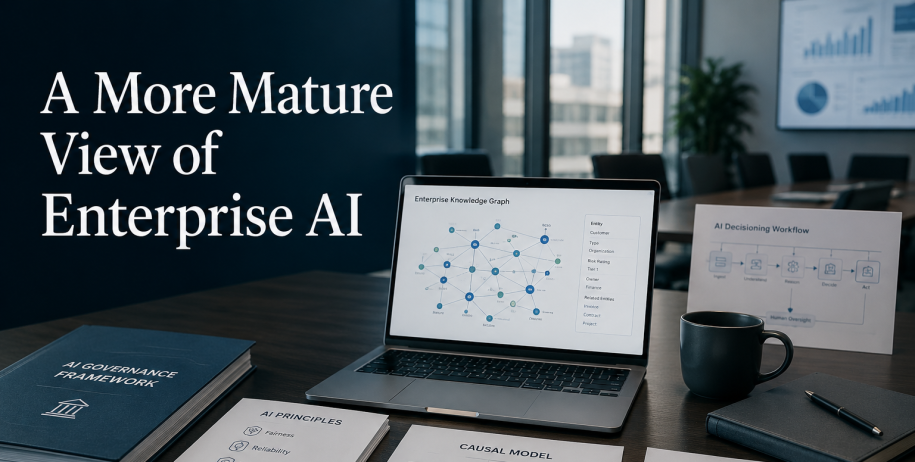
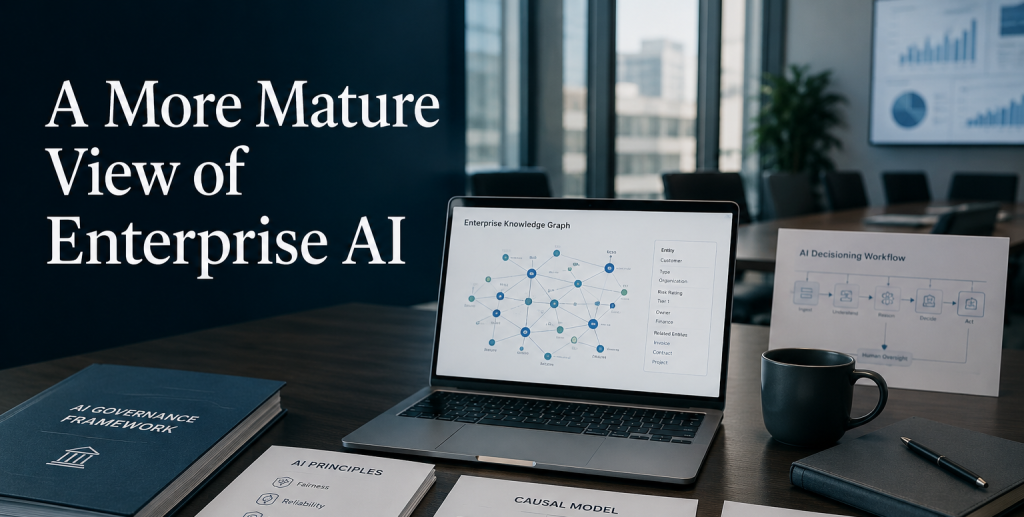
A More Mature View of Enterprise AI
We are moving beyond the idea that AI is a single capability and toward a more mature understanding of enterprise systems as combinations of different forms of intelligence, working together.
Language models, structured knowledge, causal reasoning, deterministic execution and human judgment each have a role to play, and the organizations that succeed will be those that understand how to combine them effectively rather than relying on any one in isolation.
They will not be the ones with the most AI, but the ones that use it with the most care, precision and intent.
.