

If current approaches to enterprise AI do not scale, the natural question becomes what does. As organizations push AI beyond isolated pilots, they quickly discover that document retrieval and similarity search are not enough. To scale AI across the enterprise, something more structured is required.
This is where knowledge graphs enter the conversation. Instead of treating information as disconnected documents, a knowledge graph represents entities, relationships, rules and meaning in structured form. It captures how concepts relate to one another and how the business actually works.
In theory, this provides exactly what enterprise AI needs: structure.
Why Knowledge Graphs Make Sense
Enterprise knowledge is not flat text. It is a network of relationships such as:
- Products relate to customers
- Policies relate to contracts
- Exceptions override rules
- Terms have synonyms and internal meanings
- Decisions depend on dependencies
A knowledge graph models these relationships explicitly. That makes it more aligned with the needs of enterprise AI than pure document retrieval.
If AI is to scale reliably across an organization, it must operate on structured understanding rather than isolated fragments.
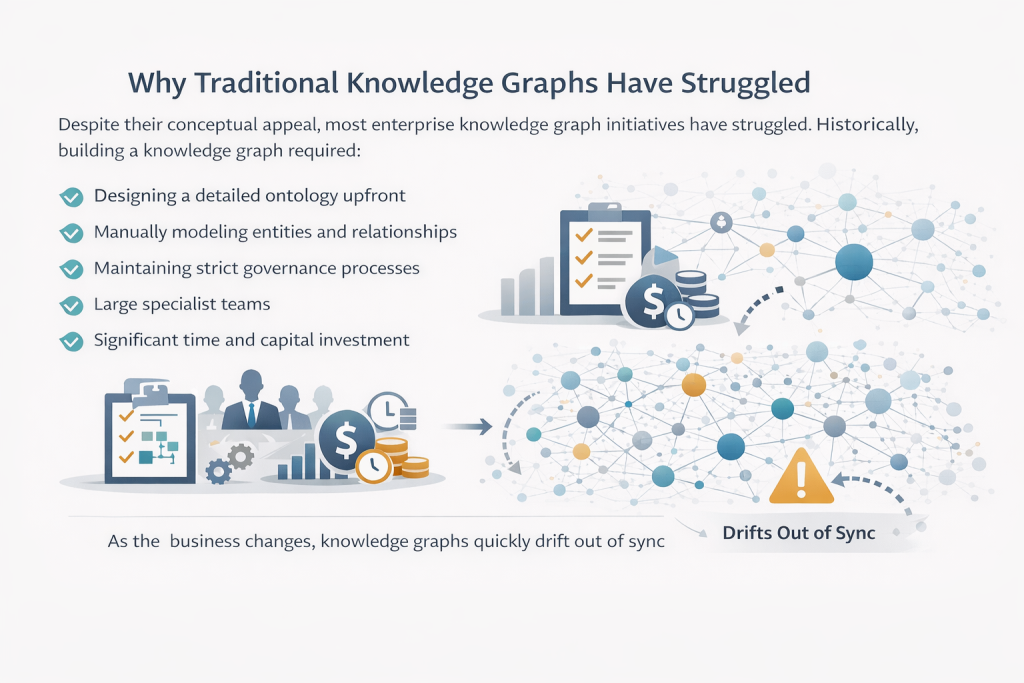
Why Traditional Knowledge Graphs Have Struggled
Despite their conceptual appeal, most enterprise knowledge graph initiatives have struggled. Historically, building a knowledge graph required:
- Designing a detailed ontology upfront
- Manually modeling entities and relationships
- Maintaining strict governance processes
- Large specialist teams
- Significant time and capital investment
For many organizations, this quickly became expensive and slow. Knowledge evolves constantly. Terminology changes. Policies shift. New products are launched. As the business changes, the graph must change with it.
Without sustained investment and discipline, knowledge graphs drift out of sync with reality.
The Palantir Exception
One company has demonstrated that knowledge graph architectures can deliver enterprise value at scale: Palantir. Its ontology driven approach validated that structured enterprise knowledge can create operational and strategic benefits.
However, it also revealed the cost of doing so. Palantir’s architecture was designed before the rise of generative AI. It is powerful but not AI native. Building and maintaining its ontologies typically requires deep consulting engagement, extensive manual modeling and sustained governance effort.
For many enterprises, deployments can take years and require significant capital investment. For highly regulated environments that model can make sense. For organizations seeking agility and broad AI adoption, it introduces friction.
The structure is valuable. The implementation model is heavy.
A Necessary Rethink
The limitation is not structured knowledge itself. The limitation has been how it is built and maintained.
What has changed is the availability of AI. Instead of constructing enterprise knowledge graphs entirely by hand, AI can now help create, curate and evolve them.
- Extract entities and relationships from documents
- Normalize terminology across teams
- Detect inconsistencies and conflicts
- Suggest structural improvements
- Continuously refine the graph based on usage
This enables a fundamentally different model. Not a static ontology designed once and frozen in time, but a living enterprise knowledge graph that evolves with the organization.
The Future of Enterprise AI
If enterprise AI is to scale, it needs structure. Knowledge graphs provide that structure. But traditional implementation models are too slow, too rigid and too expensive for most organizations.
The next phase of enterprise AI will require a new approach that combines structured knowledge with AI driven creation and curation. A model that matches the speed and complexity of modern enterprises.
The rethink has begun. And it may prove to be the missing link between AI experimentation and enterprise transformation.