
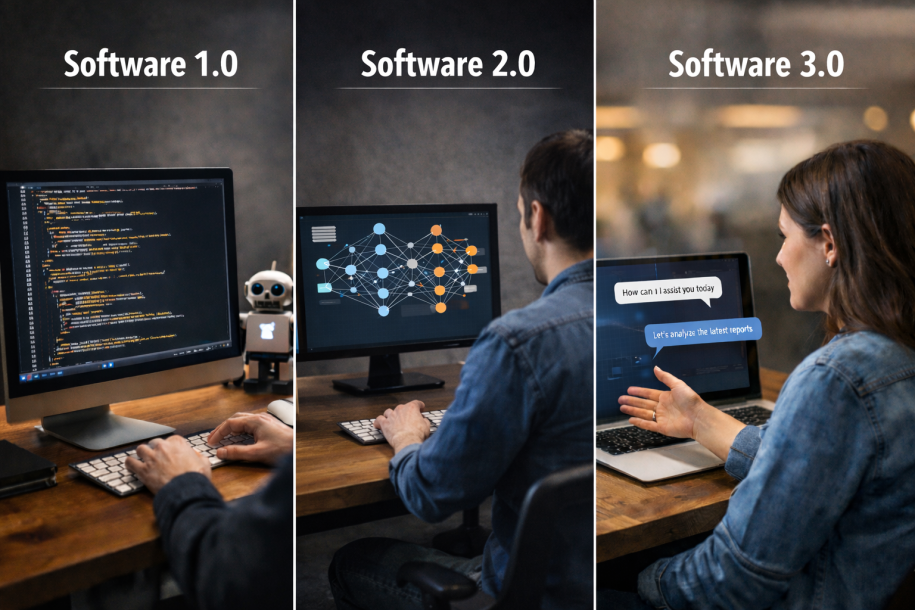
Over the past decade, software has undergone a quiet but profound shift. What began as hand written code evolved into systems trained from data. Today, we are entering a third phase, one that changes not just how software is built, but how it behaves.
This shift is often referred to as Software 3.0, a term popularized by Andrej Karpathy to describe applications driven by large language models and natural language interaction.
Understanding Software 3.0 is key to understanding how platforms like Geminos KnowledgeWay are able to do things that were previously too slow, too expensive or simply impractical.
From Software 1.0 to Software 3.0
Software 1.0 is the traditional model. Humans write explicit logic in code. Every rule, workflow and edge case must be anticipated in advance. These systems are precise but rigid, and they scale poorly when complexity grows.
Software 2.0 introduced machine learning. Instead of writing rules by hand, developers train models on large datasets. This approach powers technologies like computer vision, speech recognition and large language models themselves. While powerful, Software 2.0 systems are often opaque and difficult to adapt once trained.
Software 3.0 represents a different paradigm. Instead of encoding behavior in code or weights alone, behavior is expressed in natural language prompts and instructions, interpreted at runtime by large language models. Agents can reason, plan, ask clarifying questions and adapt their behavior dynamically.
In Software 3.0, software is no longer fully specified upfront. It is guided.
Why Software 3.0 matters for enterprises
For enterprises, the promise of Software 3.0 is flexibility.
Business knowledge is rarely clean or static. Terminology evolves. Processes change. Exceptions accumulate. Capturing this reality in rigid schemas or hand built systems has historically been slow and expensive.
Software 3.0 systems can tolerate ambiguity. They can operate effectively with partial structure, improve through interaction and adapt as the organization evolves. This makes them especially well suited to knowledge intensive problems.
The traditional problem with enterprise knowledge graphs
Enterprise Knowledge Graphs promise a shared understanding of how an organization works. In theory, they enable consistent reasoning, better analytics and more reliable decision making.
In practice, most attempts to build them fail.
Traditional knowledge graph initiatives rely on carefully designed ontologies built by specialists over long periods of time. Time to value is measured in years. Costs are high. By the time a graph is usable, the business has often moved on.
As a result, knowledge graphs have remained confined to a small number of highly resourced organizations.
KnowledgeWay as a Software 3.0 platform
KnowledgeWay applies Software 3.0 principles directly to the problem of building Enterprise Knowledge Graphs.
Rather than starting with a fully specified ontology, KnowledgeWay uses LLM driven agents to extract entities, relationships and supporting evidence from documents and other sources. Structure emerges incrementally, shaped by real data and real usage.
The agents understand intent at each stage of the workflow. They ask clarifying questions, suggest scope refinements, identify gaps and highlight potential issues. Humans remain in control, but their role shifts from manual construction to informed curation.
This is a defining characteristic of Software 3.0. Machines do most of the work, humans provide judgment.
Faster time to value, greater flexibility
By leveraging Software 3.0, KnowledgeWay delivers several advantages over traditional approaches.
Graph creation is measured in days or weeks rather than months or years. Upfront cost is dramatically lower because large ontology design efforts are no longer required. The system tolerates ambiguity and evolves as the business changes. Continuous improvement is driven by user feedback and expert input.
The resulting Enterprise Knowledge Graph is explicit, human readable and continuously improvable, rather than brittle and frozen in time.
Software 3.0 beyond the interface
While Software 3.0 is often associated with chat interfaces, KnowledgeWay goes further. Agents work in the background, guiding workflows, enforcing best practices and reducing cognitive load.
Users interact through familiar interfaces, but the real leverage comes from automation that understands goals rather than commands. This is what allows KnowledgeWay to scale knowledge engineering without scaling headcount.
A new foundation for enterprise AI
Software 3.0 changes what is economically and technically feasible.
By combining agent driven architectures with Enterprise Knowledge Graphs, KnowledgeWay turns internal documents and expertise into a living, strategic asset. It enables organizations to move beyond simple document search and toward systems that actually understand how their business works.
In that sense, KnowledgeWay is not just a product built with Software 3.0. It is an example of why Software 3.0 matters.